close

STORIES

EuropeSTORIESTravelZurich Blogging

How to plan your own wine tour in Piedmont – Barolo

My personal highlights: 48 hours wine trip in the UNESCO heritage Barolo discovering wine rarities & meditative landscapes in Langhe

When you hear the word Italy, the chances of being surrounded by good food & drinks are very high. I am very thankful of my Italian origins, they thaught me to appreciate and recognize a pure taste. There are several facts about True Italian Taste and its provenience that need to be known.

In occasion of a campaign promoted from the Italian Chamber in Zurich I got in touch with the topic “True Italian Taste” and “Italian Sounding”. This is how the Barolo Trip in Piedmont organized by “Strada del Barolo e grandi vini di Langa” came along.

What means Italian Sounding?

Italians sounding is the marketing of food and beverage produced worldwide, often labelled with Italian names and misleading Italian words and pictures. This misleading information is extremely dangerous for our Italian heritage! Reason enough why the Italian Government realized a unique mark against fakes. The project considers a brand to print on the product’s labels to fight forgery, starting from the food industry.

Important quality products have their origins in Piedmont. The world knows Barolo, the white Alba Truffle or Fiat. All of these brands have been created in this region.

Let’s mention Fiat first, since I had the pleasure to travel with a cozy Fiat500 Cabrio, Anniversario edition all the way to Alba. FIAT was founded in Turin in 1888. The Anniversario edition is dedicated to the 60th birthday of the Fiat 500. It comes in a fresh Riviera green! This retro model caught much attention all around the Langhe Piomentesi! We cruised through the valleys feeling safe. What a fun having the wind blowing through the hair listening to legendary Italian songs. The car trunk offers enough space to bring back home exquisite wine bottles! Thanks FCA Switzerland for this great opportunity! Get more information and facts about the Fiat500 Anniversario Model here.

Let’s dive into the culinary part of my travels.

Discovering Barolo & Barbaresco – UNESCO World Heritage since 2014

UNESCO rewards this region of Italy not only for being a land of vineyards, castles and medieval towers, but also for the labor of men and women down the ages. The soil of Langa has always been difficult and demanding to work: the malora, a term used by Beppe Fenoglio to describe a painful condition, reminds that the farmers who used to live in Langhe in the 1950s, had a lot of difficulties working the land.

The UNESCO site comprises the Barolo DOCG communes of Barolo, Castiglione Falletto, Grinzane Cavour, La Morra, Monforte d’Alba, Novello & Serralunga d’Alba, including the Barbaresco DOCG communes of Barbaresco and Neive.

The charm of the landscape and the geographical viticulture add ideal circumstances and incredible value to this travel experience.

During every wine tasting I appreciated much the way all the winemakers presented and shared their precious knowledge. The sparkles in their eyes can not be overseen while they explain the history of their winery. Some of the history goes back hundreds of years.

Standing between the yards, absorbing the smell and colors with all senses allows a whole picture on what wine making means.

On our Barolo trip we visited 5 wine yards in 48 hours!
That was a real challenge. Thanks to the perfect organization of  “Strada del Barolo” we managed to absorb all the facets offered by this region.

Piedmont red wine: appreciated and popular in the whole world –
What means DOC and DOCG?

It lays down the rules for its production and for admission to the market, that it has this fame. Barolo and Barolo Riserva wines have obtained the DOC with DPR 04.23.1966 and subsequently the DOCG with the DPR 07/01/1980 (Italian law). These laws and the subsequent amendments define the Production Regulation of Barolo wine.

Important characteristics of Barolo DOCG wine:

  • It’s made exclusively from Nebbiolo grapes, grown in the territory of 11 municipalities  designated by the mentioned Production Regulations.
  • It must be bottled and can age only in the defined municipalities.
  • The minimum aging of the Barolo wine is 38 months and 62 months for Barolo Riserva wine. 18 month must follow in a wooden barrel.
  • The release for consumption is permitted from 1 January of the fourth year following the harvest for Barolo wine and from 1 January of the sixth year following the harvest for the Barolo Riserva wine.
  • The grape yield must not exceed 8 tonnes per hectare.
  • The yield of wine per hectare must not exceed 5,600 liters.

The Barolo and Barolo Riserva wines must also have the following characteristics:

  • minimum alcohol content 12.5% by volume
  • They must have a ruby red color
  • The taste must be dry taste and full, elegant and harmonious.

This regulation may explain, why so much hand work is put into the production of these wines.

Piedmont Food delicacies

Everyone know, the famous White Truffle of Alba or hazelnuts, (one of the best quality hazelnuts in the world and main ingredient of many handmade sweets of the local tradition). What about Dop cheeses, hand made pasta or any kind of salumi? Gastronomy in Langa is robust and tasty. The dishes are simple and genuine.

How to plan your Piedmont tour in Barolo – Langhe – Roero and Monferrato

This blog article shall inspire to offer a good mix in term of size and region of the wineries. It can be used as a help to book a wine trip on your own. Find all the coordinates below.

Important: Absolutely schedule tasting appointments in advance, you will be grateful to all the attention and precious knowledge the winemakers can share with you. If they know about a visit, they can plan and organize this accordingly.

The partner that organized our tour was “Strada del Barolo e grandi vini di Langa“. Mario put together a tailored wine tasting experience that led through Langhe, Roero & Monferrato. You can check for a driver that makes all of the transfers.

How many wineries to visit during your weekend trip?

I recommend 2 wineries per day, if possible focus on a one area per day. With this agenda you have time to enjoy the cultural offer around the region, too. Explore some hiking or biking. Go for a shopping afternoon in picturesque Alba.

The season to travel if you’re in love with truffles is October. Spring is recommended, too. This time is less touristy and gives you the chance to see blooming wine yards!

How to find wineries for your Barolo wine tour

In this section you get introduced to a selection of wineries I have visited personally and absolutely recommend.

The grapes cultivated at Malvirà are: Nebbiolo, Arneis, Favorita, Chardonnay and a small part of Barbera.
Malvirà cultivates 42 hectares and exports all over the world, (Switzerland included). Today the estate is run by two brothers, Massimo and Roberto Damonte and their sons.
Plenty of the wines produced are 100% organic. All of them follow the defined strict regulation of Barolo. When you walk into a cellar of such a size you understand how much work is behind that business.

My personal highlight: Enjoying a dinner with one of the founder, Roberto Damante. Exploring the pairing of precious drops with delicate ingredients as the white Alba Truffle or local beef tartar. This combination makes evolve the palate with completely new flavors!

Contact:

Azienda Agricola Malvirà dei F.lli Damonte
Via Case Sparse, 144, Loc. Canov, 12043 Canale d’Alba (CN), Tel. +39.0173.978145, e-mail: malvira@malvira.com

Accommodation:
For your first night I recommend to stay at Villa Tiboldi. It is managed by the same family of the winery. The house is surrounded by a breathtaking view over the hills of Langa and Roero. The boutique hotels offers 10 comfortable rooms around 170 Euro/night. A restaurant and a swimming pool with a view over the Langhe make your stay memorable!  Experience the ideal pairing of exquisite traditional Piemontese Food with premium wines!

  •  Josetta Saffirio, Loc. Castelletto 39, 12065 Monforte d’Alba – Langhe
    This winery is located at Monforte d’Alba on Castelletto hill, facing south east, for a total of 5 hectares of vineyards mostly planted as Nebbiolo. In the early twentieth century, Josetta’s father, Ernesto, began cultivating the vineyards inherited from his father. 1952 she creates a unique Barolo, which in the nineties amazes the Italian wine scene. Josetta is the first woman giving a label to the Barolo wine. The gnomes decorating the bottles are inspired by childhood stories she was told by her father!


    My personal highlight: Putting on boots to walk inside the wine yards gives makes you smell the earth! Marco, one of the managers, guided us through his favorite hill called “Persiera”. From here you admire the complete Langa valley. Lange means tongue (IT: Lingua).  This is the shape of the wine yards! I am taught, that the color of the leafs explain the sort of a grape.

Check their project called: adopt a row! You can buy your own row and experience onsite the huge work that lies behind winemaking. Learn all the steps of wine making as the harvesting, the aging and finally the bottling. More details here.

Contact:
Josetta Saffirio Farm, Località Castelletto, 39, 12065 Monforte d’Alba (CN), info@josettasaffirio.com,
Tel. + 39 0173 787278

  • Agricola Gian Piero Marrone, Langhe
    The Company “Agricola Gian Piero Marrone” is a Family for four generations dedicated with passion to the works in the vineyards. The business is in hand of three sisters in the 4th generation. Here you experience a friendly and honest hospitality with genuine and home made dishes at reasonable prices. This place is very authentic. Find excellent products as wine olive oil, truffles and local sweets at reasonable prices.The winery is beautifully located in the middle of the Langhe hills and has a admirable terrace facing the wine yards. The restaurant invites to take a seat at tables “between” the wine barrels.
    For those who love cooking: Attend a cooking class in the winery and learn the secrets of this typical cuisine! Get more information here.

My personal highlight: Tasting an excellent Langhe doc Chardonnay “Memundis” and learning from Marco Bertone one of the managers that sulfates (mostly in white whine) are often cause of headaches. They remove oxygen from the stomach, which in turn takes it from the brain. The lack of oxygen causes headaches! Now I know where my headaches come from: no wines with sulfates, please!

Contact:
Agricola Gian Piero Marrone, Frazione Annunziata 13, 12064 La Morra (CN) Italia, tel +39 0173 509288, e-mail: marrone@agricolamarrone.com

  • Cantina Cascina Castlèt – Between Alba and Asti
    Costigliole d’Asti is one of the most enchanting centers in Alto Monferrato. From the valley of Tanora the landscape rises to gentle hills up to the 300 m above sea level. M. Frazione San Michele, from where you can enjoy a magnificent view to the Alps. The soil conditions are ideal for viticulture.
    Local grape varieties are: Barbera, Moscato, Uvalino and NebbioloCabernet Sauvignon and Chardonnay. This variety has been grown in Costigliole since the late 18th century. Cascina Castlèt used to belong to the Borio family for generations. Mariuccia inherited it from her father in 1970.

    My personal highlight:
    Exploring a wine cellar with a mystic touch. It reminds me of a place where the magic happens. The wine is refined until it gets to the result to be a rubin red Barbera.

    Contact:
    Cascina Castlet
    Str. Castelletto, 6, 1405 Costigliole d’Asti, Tel.: +39 0141 966651, Email: info@cascinacastlet.com

    Accommodation:
    Villa Loreto, Strada del Loreto, 33, 14055 Castigliole D’Asti – www.villa-loreto.com
    A little paradise for your relax with an amazing view managed by a Swiss couple that fell in love with this region. The stylishly furnished homes with private pools are located in a private estate of 35’000 m2. Maria introduces me into the exploration of Asti Spumante in food recipes! I love to share my favorite Piedmont Dessert with you, it’s prepared super fast and easy!

Zabaione al Moscato d’Asti

Ingredients: 1 egg, 4 egg yolk, 1dl Moscato d’Asti, 50 grams of sugar

Preparation:
In a saucepan placed in a bain-marie, add the Moscato d’Asti and the sugar to the egg yolks and the whole egg. Use a wire whip to mix slowly until it gets warm, stir until the mixture is soft and creamy. Remove from heat and immediately strain with biscuits or a hazelnut cake.

  • La Casaccia – Monferrato
    This area is somewhat overshadowed a bit by Barolo and Barbaresco. Be prepared of very exclusive and delicate wines made with the Grignolino or the Freisa grapes. At La Casaccia they produce elegant traditional drops interpreted in a modern way. Giovanni loves to experiment with the grapes and offers very intellectually wines that reflect the positive elements of the character of Giovanni and his family.
    The winery La Casaccia is located in a house from the 17th century. Today it is renovated to a jewel including a cozy B&B. Walking in the base where the wine cellar is feels like visiting an ancient museum. Some bottles are hundreds of years old. The cellar excavated in the underground is a rarity. It made this region become a World Heritage Site of UNESCO, too.

Do you know the Grignolino grape?
I did not. It’s a famous grape from the region of Monferrato. It is a wine of character and full of discoveries. With its natural spiciness it’s perfect for those who love the intriguing flavors. Grignolino is very delicate wine and difficult to cultivate. The grape is sensitive to diseases and requires a lot of care and attention.

My personal highlight: Try their wines at dinner, spend a night at their cozy B&B and get spoiled by the traditional and genuine cooking skills of Elena. I absolutely loved their La Casaccia metodo classico sparkling wine made of Chardonnay grapes.

If you are planning a longer time off from home and are interested in helping in the wine yards, this is a place to do such a project. Get in contact with them!A specialty we tried was a flan made of broccoli, a veal involtino stuffed with artichokes and some fresh cheese and salumi. Feel like eating at a family table. We shared lovely stories of life zipping on our glass. The breakfast in the morning is the cherry on the top. A lukewarm hazelnut cake made only with egg white and local hazelnuts! No butter and practically no sugar. Thank you Giovanni, Elena, Margherita and Marcello for this very hearty evening spent with you sharing our stories of life.

Contact:
Azienda Vitivinicola La Casaccia, Via Barbano Dante 10, Cella Monte, 53010, Tel. 0039 (0)142 489 986, E-Mail: vini@lacasaccia.biz

Accommodation:
Simple but very cozy and authentic rooms. It’s a very typical historical building in Cella Monte from the 17th century renovated with much love. Get more here.

Interested in other travel stories? Visit my travel section here.

read more
STORIESZurich Blogging

A true taste of Tuscany: learning the secrets of artisan quality products

Back in the 70s, an Italian family immigrated from south Italy to Tuscany transporting 2000 sheep on a ferry to fulfil the dream of their cheese factory

During my press trip organized by Buyfood Tuscany, I had the chance to hear the most beautiful stories of Italian food entrepreneurs. Before starting with the stories, let me share with you some important facts about this annual event taking place to promote the true Italian taste in the region of Tuscany.

  • Buyfood Toscana 2021 is an international showcase of certified agri-food products promoted by the Region of Tuscany 
  • Over 2 thousand tastings take place across 48 hours dedicated to foreign buyers from 19 countries around the world. If you are a buyer, this is your event to mark on the agenda for next year! You get the chance to taste products and talk to experts from the sector.
  • The region of Tuscany comes first for the denominations and cultivated areas: They have over 70 thousand hectares* with 31 certified productions*, which is one of the highest concentrations of farmhouses in Italy!
  • With 31 agri-food products* (16 DOP and 15 IGP) recognized at the EU level, in 2021, Tuscany represents 10% of national GI awards. Do you like to read more about this certification? Check my blog post here and even find a recipe on how to prepare your Tuscan dish at home!

Let’s dive into the visited Tuscan artisan products

First stop: Production of the Pecorino delle Balze DOP at Fattoria Lischeto, Volterra

A series of landslides caused by the erosion of clayey soils created the unique, characteristic landscape of Volterra. Some experts claim, that this region provided the backdrop to some of Leonardo da Vinci’s most famous paintings. And since food and art are very well connected, this valley is predicted to offer one of the most prestigious pecorino cheeses of Tuscany!

Very close to Volterra we meet Giovanni Cannas, the owner of the farm Fattoria Lischeto. He introduces us to the properties of the pecorino cheese and his personal business story. His grandfather came to Tuscany from Sardinia in the 60s. With him came 2000 sheep by boat! This man was Giovanni’s muse and introduced him to cheese making. Giovanni shares with enthusiasm how he built his business from a young age. Can you imagine that he used a loaf of cheese as a means of payment to get into discos? His nights were long by that time, after dancing at the disco he spent several more hours in his cheese production. The cheesemaker owes his breakthrough to the famous Italian singer Renato Zero. He tasted Giovanni’s cheese at an event and from then on he became his loyal customer.

What makes the Pecorino delle Balze Volterrane DOP special?

The delicate cheese is made exclusively with raw, whole sheep’s milk and vegetable rennet sourced from wild cardoon or artichoke inflorescences. The use of vegetable rennet instead of animal rennet gives the product organoleptic characteristics that make it sweeter than other cheeses made from sheep’s milk.

How to enjoy this pecorino cheese best? 

It’s eaten “fresh and “semi-seasoned” as an appetizer, along with cured meats and vegetables in oil, or as a table cheese. The “seasoned” or “da asserbo” variants, on the other hand, are usually grated on first courses seasoned with meat sauce, or in soups and stuffed pasta. It goes very well with Tuscan red wines, including aged ones. We enjoyed a fantastic lunch prepared at Giovanni’s Farm. My absolute highlight was the soft and tasty gnocchi with minced sheep ragu meat and for dessert, the delicate ice cream prepared with fresh sheep milk!

I recommend visiting this holiday farmhouse and staying there for 2 nights! Book your trip here!

Do you like to have more information about the consortium? Find them online consorziopecorinobalzevolterranedop. The Consortium for the Protection of Pecorino delle Balze Volterrane DOP brings together growers. For many years, the Consortium has guaranteed that only pecorino cheese that complies with the production regulations can be called Pecorino delle Balze Volterrane DOP.

Second stop: Tour at the oil mill of the cooperative Agricola Olio Terre dell’Etruria, Castagneto Carducci with an olive oil tasting

Together you are just stronger! The cooperative Terretruria Toscana has about 3500 associated farms. It represents the most important entrepreneurial reality of the Tuscan agricultural section. What fascinated me a lot is the fact, that they produce biogas out of the stones from the olives and contribute to renewable energy, too and nothing is wasted from the olives. 

1000 tons of olives are processed a day

After the visit to the production site, we had the opportunity to taste different of their olive oils. With the guidance of a group of experts, we could find out the different flavours and characteristics of their extra virgin olive oils.

Some principal typical Tuscan olive cultivars you need to know!

The extra virgin olive oils from Frantoio olives are characterised by a medium-intense fruitiness, bitterness, and pungency, with a prevailing aroma of fresh almond and light notes of freshly-cut grass/green leaves and artichoke.

The extra virgin olive oils from Leccino are medium fruity in the taste, with medium-light bitterness and pungency and a prevailing aroma of fresh almond and light notes of freshly-cut grass/green leaves and artichoke

Extra virgin olive oils from Leccio del Corno are characterized by a medium-intense fruitiness, bitterness, and pungency, with a prevailing aroma of freshly-cut grass/green leaves, fresh almonds, and tomato.

My favorite Tuscan olive oil tastes Fragrant, soft, light, aromatic, pleasantly spicy, and bitter, with low acidity!

Extra virgin olive oil Toscano IGP

This oil is obtained from three indigenous olive varieties: FrantoioLeccino and Moraiolo. The olives are hand picked and come from 5 distinct sub-regions as Colline di Arezzo, Colline di Firenze, Colline della Lunigiana, Montalbano and Monti Pisani.

If you are travelling around Tuscany, don’t miss the “olive oil roads” where you can discover more about this delicious olive oil.

Third stop: Production of the Lardo di Colonnata IGP, Larderia Sanguinetti, Colonnata (Carrara)

The last visit of our press hit the production of the IGP labelled Lardo di Colonnata up in the valley Colonnata which is close to Carrara and very well known for its marble.

What do you think marble and lard have in common?
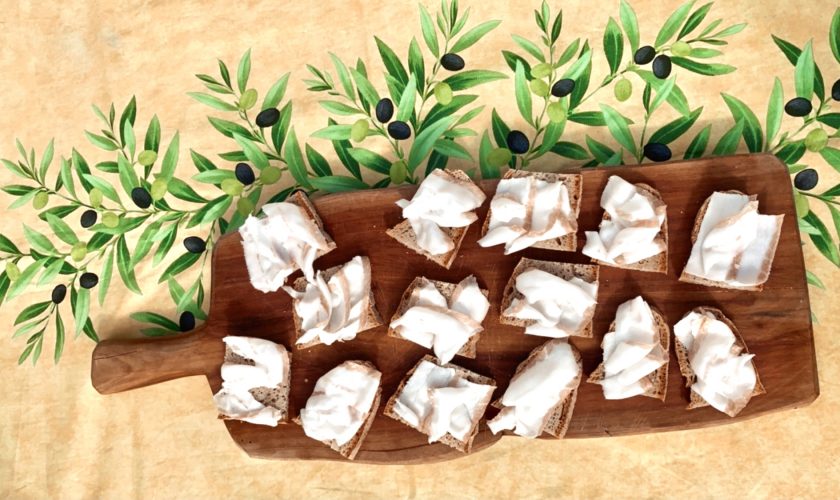
Have a closer look at the lard, doesn’t it have a fine structure as marble? Standing in front of the Colonnata mountains observing the lines of the mountains, on the other hand, holding the lardo bruschetta I feel like they have a lot in common!

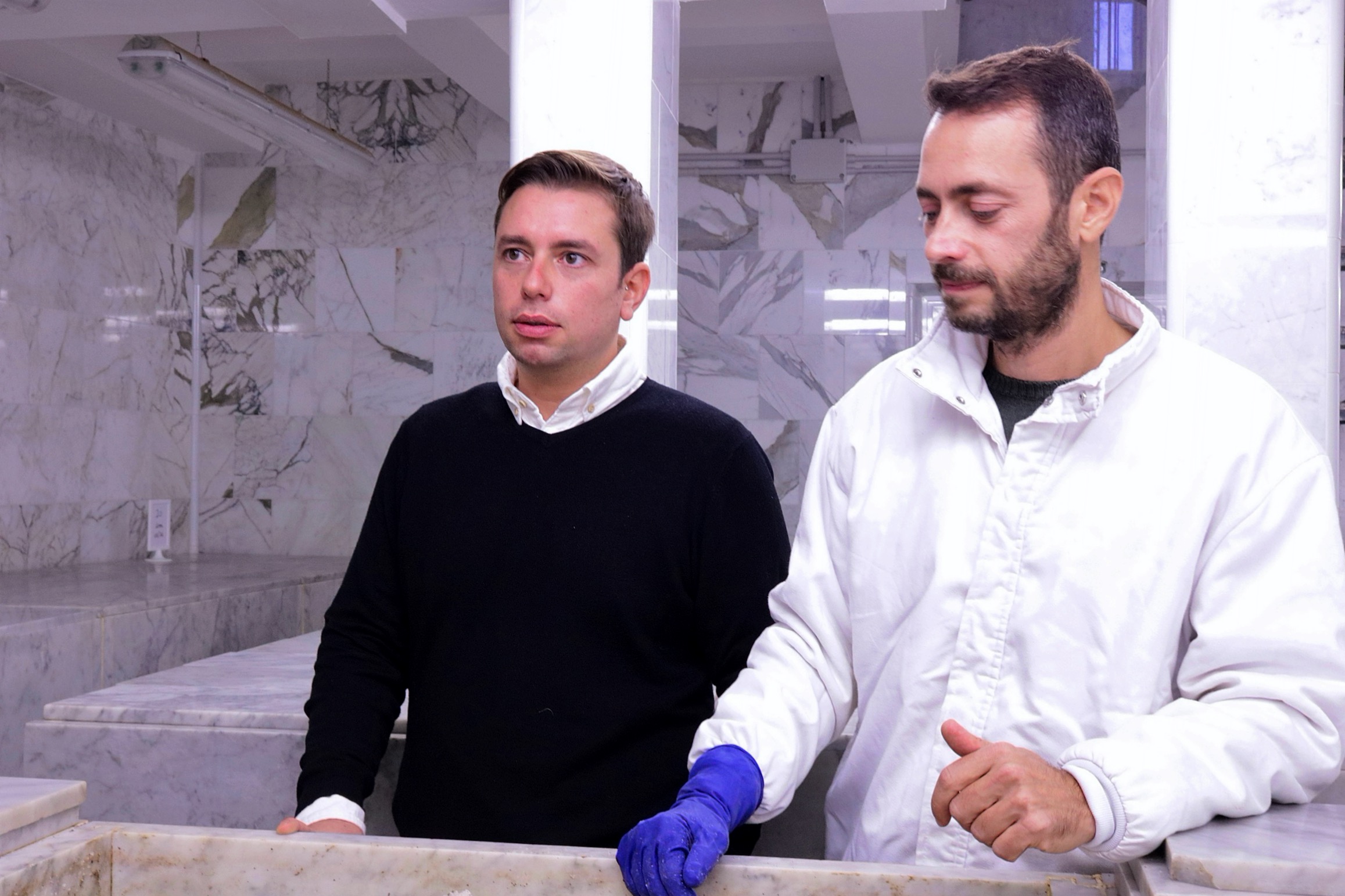
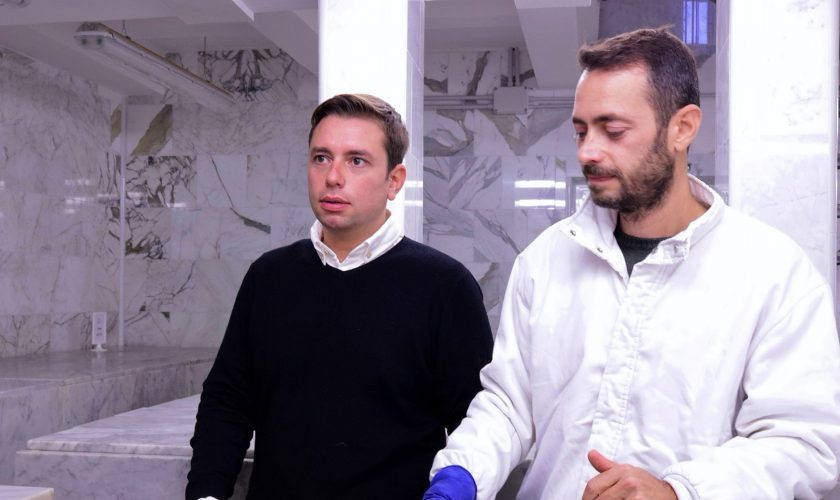
The production of the lardo di Colonnata IGP follows a very strict protocol to achieve the IGP label. Emanuele and his brother showed us around their facilities and explained the procedure of production. The lard is taken specifically from the back of the pig. Several Cuts of fat are layered with salt, rubbed with garlic, and then seasoned with rosemary and sometimes sage, star anise, cloves, or other spices. After the lard is placed in marble tubs, called conche, more marble is used to cover it. The ageing time is at least 6 months. A particularity you have to know: the marble in Colonnata has a very fine grain that makes it a perfect, breathable tub for curing the lard.

For some Tuscans, aging salt-rubbed pork fat to a voluptuous ooze is as high an art as David

Emanuele and his brother started this business during the economic crisis in Italy back in 2008. Many of their friends left the region to seek their luck abroad. The two brothers felt the urge to stay in Carrara and give their local artisan production a chance. They are among the most important producers of the Lardo di Colonnata IGP and export to Europe and local Italian gastronomy retailers.

How to enjoy the lard best

Locals prefer to enjoy the sweet, savoury, and creamy lard by itself or with a crust of bread! It pairs well with polenta or seafood, too. The combination of bread and fat was a traditional miner’s lunch. The calories which locals credit were keeping marble workers strong. The lard pairs well with polenta or seafood, too.

This culinary trip was full of discoveries for me! I left Tuscany with memorable food stories and great new food friendships!

I big thank you to Buyfood Toscana and the organizer Mariangela Della Monica – Head of the FST press office – for inviting me to this culinary excursion!

Get inspired by more of my travel stories here!


* Source
– DOP IGP numbers: Ismea-Qualivita Economic Observatory 2020
– Ismea research for Buyfood Toscana “Current context and future prospects of Tuscan agri-food GIs”, October 2021.
read more
1 2 3 4 7
Page 2 of 7